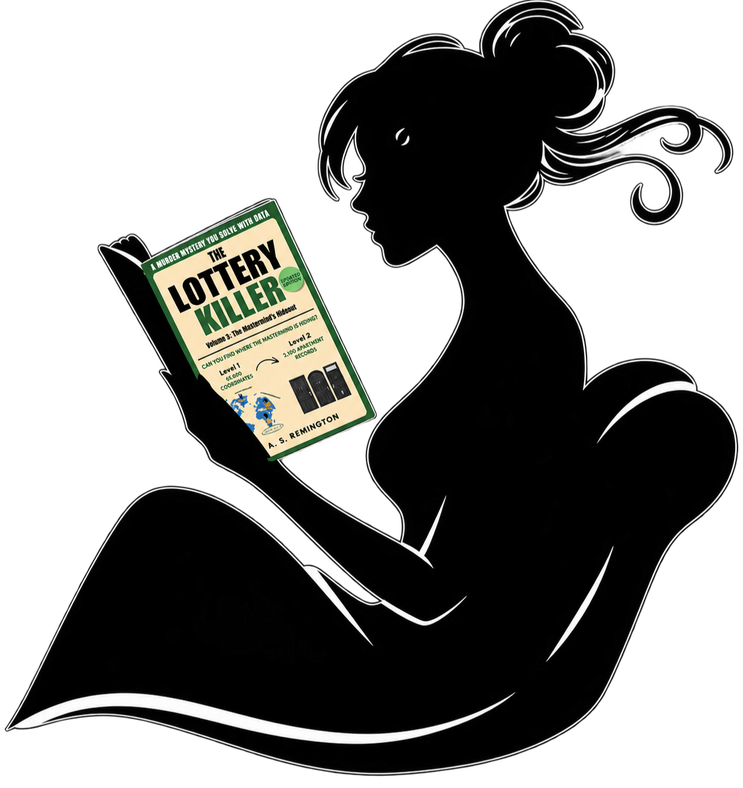
The Lottery Killer Volume 3 Updated Edition: An Immersive Murder Mystery Logic Puzzle
by A. S. Remington
Available exclusively on Amazon
Wherever you are, you can grab a copy of "The Lottery Killer Volume 3". Just pick your local Amazon store from the links below.
Solution
Clara left a way to reach her. If you have worked through the coordinates, applied every clue, and believe you have found the one, send word and confirm your answer.
Hints
Stuck between two possibilities? Click here for spoiler-safe guidance.
Clues
Looking for the clues? Click here to take a look.
Book Updates
Want to see the latest book updates? Click here for details.
FAQs
Need clarification before submitting your answer? Click here for common questions.
Contact
Questions, corrections, or feedback? If you found a printing issue, need clarification, or would like to share your thoughts about the puzzle, we would be delighted to hear from you at [email protected]

The Lottery Killer Volume 3 Updated Edition: An Immersive Murder Mystery Logic Puzzle
Send Word to Clara
Contact
Questions, corrections, or feedback? If you found a printing issue, need clarification, or would like to share your thoughts about the puzzle, we would be delighted to hear from you at [email protected]

The Lottery Killer Volume 3 Updated Edition: An Immersive Murder Mystery Logic Puzzle
Hints
A NOTE FROM CLARAI didn't have much time. But I was careful. Everything you need is in the book, but pay attention to exactly what each clue asks you to use. This time there are two levels, two archives, and thirteen clues in each. These are the things I wish someone had told me when I started.— C.P.
Start with the clues that sweep a whole pageSome clues eliminate every coordinate on a page in a single pass. Others judge one coordinate at a time. Work the page-level clues first, they clear the field fastest. You'll know them because they ask you to look at the whole page's contents, not just the coordinate in front of you.
Crossed out does not mean forgottenOnce a record is eliminated, keep it crossed out. However, it may still need to be counted, compared, matched, or used as a marker by another clue.
Use Clara’s Atlas exactly as printedFor Level One, only the exact coordinates listed in Clara’s Atlas count for London, Athens, Seven Wonders, UNESCO Heritage Sites, and capital cities. Do not substitute nearby or real-world alternatives.
Every coordinate carries the same two pieces of informationLatitude first, longitude second, each with its hemisphere letter. Some clues compare a coordinate to itself. Others compare it to its neighbors, its page, or its facing page. Know which one you're being asked to do before you start counting.
Reading order matters more than it looksCoordinates are read left to right across each row, then down the page, continuing onto the next Coordinate Archive page. When a clue asks for the previous coordinate, use this exact order.
Check facing pages correctlyA facing page is the archive page directly opposite the page you are examining in the open book, not simply the previous or next page number. Facing-page clues appear in both levels.
Count panels, not their shapeWhen a clue refers to panel count, count only the number of visible panels. Rounded, square, or rectangular panel shapes do not change the count. Door shape/type and panel count are separate properties.
A bar knocker is always a bar knockerA bar knocker may be horizontal or vertical, but both count simply as Bar knocker. For the clues, the knocker types are only Ring, Bar, or None.
Upper transom doors are their own door typeTreat an Upper Transom door as a separate category from a Flat-top door. Even if the main lower part of the door looks flat, an Upper Transom door is not counted as Flat-top. Use the three door types separately: Rounded-top, Flat-top, and Upper Transom.
Ignore door details the clues do not useFor Level Two, focus only on door shape/type, panel count, handle side, mail-slot type, and knocker type. Ignore peepholes, handle style, visible hinges, and decorative differences unless a clue specifically says otherwise.
Read every boundary word exactlyWords such as more than, fewer than, at least, within, strictly before, strictly after, and no more than are deliberate. A difference of one can change whether a record survives.
Contact
Questions, corrections, or feedback? If you found a printing issue, need clarification, or would like to share your thoughts about the puzzle, we would be delighted to hear from you at [email protected]

The Lottery Killer Volume 3 Updated Edition: An Immersive Murder Mystery Logic Puzzle
Frequently Asked Questions
The final volume now unfolds across two connected levels. These are the questions readers are most likely to have while working through Clara’s Coordinate Archive and Apartment Archive. If you are right, and I hope you are, the police will finally act.— Clara
Does the book include the solution?No. The solution was never mine to put in a book. If you have worked through the archive and applied every clue, you already know your answer. If you are right, submit it and find out what Clara found there, and what happened to Richard Hale.
How many clues are there, and do I need to complete them in order?There are twenty-three clues. The first twenty-two can be applied in any order, and each one eliminates coordinates independently. The twenty-third, The Western Edge, is different: it can only be applied once the other twenty-two are done and the survivors are known. Apply it last.
I have applied all thirteen Level One clues and no coordinates remain. What went wrong?A clue has probably been applied too broadly. Remember that an eliminated coordinate may still need to be counted, compared, or used as a marker by another clue. When a clue asks you to examine a page, use the original printed archive, including coordinates you have already crossed out.
I have applied all thirteen clues and several answers remain. Is that expected?No. Each level is designed to leave exactly one survivor. If several remain, one or more clues have probably been missed or applied too narrowly. Re-check page-level clues, exact boundaries, facing pages, and any clues that use markers or comparisons.
What does "facing page" mean in the clues?The book opens as a standard printed book: left-hand and right-hand pages that sit together when the book is open. Every left-hand page faces the right-hand page across from it, and that pairing does not change even if you turn one page ahead. When a clue refers to the facing page, it means that opposite page and not the page before or after it in the stack.
What does "reading order" mean?For the Coordinate Archive, read left to right across each row, then continue down to the next row and onto the next Coordinate Archive page. When a clue asks for the previous coordinate, use the entry immediately before it in this continuous order. Chapter-opening pages are ignored.
Do I need Clara's Atlas for every clue?No. Only some clues refer to it: capitals, the Seven Wonders, UNESCO landmarks, and the reference cities. When a clue does refer to the Atlas, only the coordinate printed exactly as shown there counts. A nearby or similar coordinate does not.
I submitted an answer and it was wrong. Can I get a hint?Yes. The hints page will help you without giving anything away. Work through the clues one at a time. Clara designed the clues to be solvable, not to defeat you.
I think I have found a duplicate coordinate. Is that an error?Not necessarily. Exact repeated coordinates can be intentional. In Level One, Clue 10 specifically asks you to look for an exact coordinate repeated on the same archive page. Treat every printed appearance as a separate entry unless a clue tells you otherwise.
Do the shapes of the panels matter?No. When a clue refers to panel count, count only the number of visible panels. A rounded-top door may have rounded panels or square/rectangular panels; that does not change its panel count. Door shape/type and panel count are separate properties.
Is an Upper Transom door also a Flat-top door?No. Upper Transom is its own door type and must be treated separately from Flat-top and Rounded-top. The three door types are Rounded-top, Flat-top, and Upper Transom.
Does the direction of a bar knocker matter?No. A bar knocker may appear horizontally or vertically, but both count simply as Bar knocker. For the clues, the only knocker categories are Ring knocker, Bar knocker, and None.
Do all the visible details on the apartment doors matter?No. For the current clues, use only door shape/type, panel count, handle side, mail-slot type, and knocker type. Peepholes, handle style, hinge visibility, panel shape, and decorative details should be ignored unless a clue specifically tells you otherwise.
If I cross out an apartment, can it still matter later?Yes. Once an apartment is eliminated, it stays eliminated, but its original information may still need to be counted, compared, matched, or used as a marker for another clue. Always use the original printed archive when a clue asks you to examine a page.
Do I need to refresh the page to try another answer?Yes. If your answer is incorrect and you would like to submit again, refresh the page and complete the verification form again.
Do I need to have read Volume 1 or Volume 2 to solve Volume 3?No. Volume 3 is self-contained. The story references events from the first two books, but all the information you need to solve this archive is inside this book. If you have read Volumes 1 and 2, you will recognize how the threads connect.
Will there be a fourth book?No fourth Pembridge Manor book is planned. This case closes here, and solving it means giving Clara her life back. Whether it's Clara again or someone else entirely, this won't be the last mystery we bring you.
Contact
Questions, corrections, or feedback? If you found a printing issue, need clarification, or would like to share your thoughts about the puzzle, we would be delighted to hear from you at [email protected]

The Lottery Killer Volume 3 Updated Edition: An Immersive Murder Mystery Logic Puzzle
Privacy Policy
We respect your privacy.When you submit your name and email address through this website, the information is used to verify your solution, respond to questions, and maintain records of puzzle submissions.If you choose to opt in by checking the newsletter and Advance Reader Team box, your email address may also be used to send occasional updates about new books, exclusive puzzles, and opportunities to receive early copies in exchange for feedback.We do not sell, rent, or share your personal information with third parties.You may unsubscribe from future emails at any time, and you may request removal of your personal information by contacting [email protected]

The Lottery Killer Volume 3 Updated Edition: An Immersive Murder Mystery Logic Puzzle
LEVEL ONE — CLARA'S COORDINATE CLUES
HOW TO USE THESE CLUESApply all thirteen clues to every coordinate in the archive. Cross out each coordinate that fails a clue. Work in any order you like, the order does not change the result. Exactly one coordinate survives all thirteen clues. That coordinate completes Level One and identifies where the investigation continues.
CLUE 1: MATCHING LEADS.
For each coordinate, take the first numerical digit of the latitude and the first numerical digit of the longitude. Cross out the coordinate if those two digits are the same.
Example: 44.80°N, 20.47°E begins with 4 and 2, so it survives. 48.21°N, 48.90°E begins with 4 and 4, so it is crossed out.
CLUE 2: EAST OF ATHENS.
Use the longitude of Athens exactly as printed in Clara's Atlas. Cross out every coordinate whose longitude lies at or east of Athens. Keep only coordinates whose longitude lies west of that meridian. All western longitudes lie west of Athens and therefore survive this clue.
Example: A longitude of 78.04°E lies east of Athens and is crossed out. A longitude of 10.12°E lies west of Athens and survives.
CLUE 3: THE PREVIOUS STEP RAN EAST.
Cross out the candidate if its predecessor lies at the same longitude or farther west. Keep it only when its predecessor lies farther east. The very first coordinate in the archive has no predecessor and is crossed out.
Example: If 33.41°N, 21.05°E is preceded by a coordinate at 27.60°E, it survives because 27.60°E lies farther east. If the predecessor lies at 21.05°E or farther west, cross it out.
CLUE 4: AT OR ABOVE LONDON.
Cross out every coordinate whose latitude lies at or north of the latitude of London in Clara's Atlas. Keep only coordinates whose latitude lies south of that parallel.
Example: 53.30°N lies north of London and is crossed out. 45.16°N lies south of London and survives.
CLUE 5: THE SMALL SUM.
Add together every digit printed in the latitude and longitude. Ignore decimal points, degree symbols, commas, and the letters N, S, E, and W. Cross out the coordinate if the total is less than 20.
Example: 46.92°N, 8.71°E → 4 + 6 + 9 + 2 + 8 + 7 + 1 = 37, so it survives. 10.11°N, 2.30°E → 1 + 0 + 1 + 1 + 2 + 3 + 0 = 8, so it is crossed out.
CLUE 6: NEAR A HERITAGE SITE.
Use Clara's Atlas to identify exact UNESCO World Heritage coordinates. Keep every coordinate whose page lies within three archive pages of a page containing a Heritage coordinate. Cross out coordinates on all other pages.
Example: If a Heritage coordinate appears on page 70, then pages 67-73 survive. Count archive pages, not physical sheets or chapter openers.
CLUE 7: A WONDER ON THE PAGE.
Use Clara's Atlas to identify the exact coordinates of the Seven Wonders. Cross out every coordinate on a page that contains none of those Wonder coordinates.
Example: If the Great Wall coordinate appears anywhere on a page, every coordinate on that page survives this clue. A page without any Wonder coordinate is crossed out in full.
CLUE 8: THE FACING PAGE LOOKS NORTH.
For each coordinate, examine its facing page in the open book. Cross out the coordinate if that facing page contains more than 24 Southern-hemisphere coordinates, meaning latitudes printed with an S.
Example: A facing page with 18 Southern coordinates allows the candidate to survive. A facing page with 30 causes it to be crossed out.
CLUE 9: BETWEEN THE MARKERS.
Two coordinates appear exactly once each in the entire archive: 46.45°N, 13.32°E and 51.65°N, 19.80°E. Find the pages containing these two coordinates. Keep those pages and every Archive Page between them. Cross out all pages outside that range.
Important: This is a page-based clue. The row and column of either marker does not matter; the whole first page and the whole last page survive.
CLUE 10: A COORDINATE TWICE OVER.
Look for an exact coordinate repeated in two different positions on the same page. If a page contains any such repeat, cross out every coordinate on that page. Keep pages on which every complete coordinate appears only once.
Example: If 42.18°N, 11.64°E appears twice on one page, every coordinate on that page is crossed out. A page with no exact repeated coordinate survives.
CLUE 11: THE SEVENS ON THE PAGE.
Count how many coordinates on the page have a latitude whose final printed digit is 7. If fewer than eleven coordinates meet this condition, cross out the entire page. If eleven or more meet it, the page survives this clue.
Example: 37.27°N ends in 7 and counts. 51.70°N does not count, because its final printed digit is 0. A page with thirteen qualifying latitudes survives; a page with only nine is crossed out in full.
CLUE 12: THE PAGE THAT CLIMBS.
On each page, compare the latitude of the first coordinate at the top-left with the latitude of the last coordinate at the bottom-right. Keep the page only if the last coordinate is farther north than the first. Otherwise, cross out the entire page.
Example: A page beginning at 31.77°N and ending at 48.59°N survives. If the last latitude is equal to or south of the first, every coordinate on that page is crossed out.
CLUE 13: A CAPITAL AMONG THE ROWS.
Find the capital-city coordinates listed in Clara's Atlas. For each coordinate, check whether one of those capitals appears on the same page within eight rows. If yes, the coordinate survives. If not, cross it out. Count rows only; the column does not matter.
Example: If a capital appears on row 5, coordinates on rows 1-13 of that page are within eight rows and survive. A coordinate on row 14 or lower is too far away and is crossed out.
That coordinate completes Level One and identifies where the investigation continues.
Contact
Questions, corrections, or feedback? If you found a printing issue, need clarification, or would like to share your thoughts about the puzzle, we would be delighted to hear from you at [email protected]

The Lottery Killer Volume 3 Updated Edition: An Immersive Murder Mystery Logic Puzzle
LEVEL TWO — CLARA'S APARTMENT CLUES
HOW TO USE THESE CLUESApply all thirteen clues to every door in the archive. Cross out each door that fails a clue. Work in any order you like, the order does not change the result.
CLUE 1: THE FIRST AND LAST DIGITS OF THE APARTMENT NUMBER ARE NOT THE SAME.
Look only at the apartment number. If its first and final digits match, cross that door out.
Example: Apartment 707 begins and ends with 7, so cross it out. Apartment 714 begins with 7 and ends with 4, so leave it standing.
CLUE 2: THE APARTMENT IS NOT IN WING 'G'.
If the printed wing is 'G', cross that door out.
CLUE 3: THE APARTMENT IS NOT ON FLOOR '1' OR FLOOR '3'.
If the printed floor number is '1' or '3', cross that door out.
CLUE 4: A ROUNDED DOOR DOES NOT BELONG ON AN EVEN-NUMBERED FLOOR.
Cross a door out only when both conditions are true: the door has a rounded top, and the printed floor number is even.
CLUE 5: A FOUR-PANEL DOOR IS NOT LOCATED IN CORRIDOR '1' OR CORRIDOR '2'.
Cross a door out only when it has exactly four visible panels and belongs to Corridor '1' or Corridor '2'.
CLUE 6: A DOOR WITH ITS HANDLE ON THE LEFT IS NOT IN WING 'A', WING 'B' OR WING 'C'.
Cross a door out only when its handle is on the left and it belongs to Wing 'A', 'B' or 'C'.
CLUE 7: THE APARTMENT IS NOT IN CORRIDOR '3' ON A TWO-DIGIT FLOOR.
Cross a door out only when it belongs to Corridor '3' and its floor number contains two digits.
CLUE 8: THE APARTMENT’S WING APPEARS FEWER THAN FIVE TIMES ON ITS PAGE.
For each door, count how many doors on that page belong to the same wing. If that wing appears five or more times, cross out every door from that wing on the page. Doors belonging to other wings on the same page remain possible.
Example: if Wing 'D' appears five times, cross out those five Wing 'D' doors only.
CLUE 9: THE TOTAL NUMBER OF VISIBLE PANELS ON THE PAGE IS GREATER THAN '47'.
Count the visible panels on all sixteen doors on the page. Treat the layouts as follows: one large central panel = 1; two-panel door = 2; four-panel door = 4; six-panel door = 6.
Add the panel counts for all sixteen doors. If the total is 47 or less, cross out the entire page. If the total is 48 or more, the page survives this clue.
CLUE 10: THE PAGE FACING THE HIDING PLACE’S PAGE DOES NOT CONTAIN TWO DOORS WITH THE SAME FOUR IDENTIFYING FEATURES.
Two doors count as a match only when all four of these features are identical: door shape (flat, rounded or upper transom), handle side (left or right), mail-slot type (horizontal or vertical) and knocker type (bar or ring). If a page contains at least one matching pair, cross out every door on the page directly facing it. The page containing the matching pair remains possible.
A matching pair still acts as a marker even if one or both doors have been crossed out by another clue.
CLUE 11: THE APARTMENT PAGE LIES STRICTLY BETWEEN THE PAGES CONTAINING APARTMENT # '2612' AND APARTMENT # '7641'.
Find Apartment # '2612' and Apartment # '7641' in the Apartment Archive. Cross out every page before the page containing Apartment # '2612'. Cross out every page after the page containing Apartment # '7641'. Also cross out the pages containing Apartments # '2612' and '7641' themselves. Only the pages between those two marker pages remain possible.
CLUE 12: THE APARTMENT IS NOT ON THE PAGE IMMEDIATELY BEFORE AND AFTER A MARKER PAGE: WING 'F' DOOR WITH A VERTICAL MAIL SLOT WHOSE APARTMENT NUMBER ENDS IN '5'.
A door qualifies as a marker only when all three conditions are true: it belongs to Wing 'F', it has a vertical mail slot, and its apartment number ends in '5'.
For every qualifying marker page, cross out every door on the page immediately before it and the page immediately after it. The marker page itself remains possible. A qualifying door remains a marker even if another clue has crossed it out.
CLUE 13: A DOOR WITH A RING KNOCKER IN CORRIDOR '3', WHOSE APARTMENT DIGITS ADD TO ITS FLOOR NUMBER, APPEARS NO MORE THAN FOUR PAGES AWAY FROM THE HIDING PLACE.
A door qualifies as a marker only when all three conditions are true: it has a ring knocker; it belongs to Corridor '3'; and the sum of the digits in its apartment number is equal to its printed floor number.
Example: Apartment '1206' on Floor '9' passes the number test because 1 + 2 + 0 + 6 = 9. It is a marker only if it also has a ring knocker and is in Corridor '3'. For each marker, keep the marker page and the four pages before and after it. Cross out every door on pages that are more than four pages away from every marker. The marker page counts as zero. Qualifying markers remain active even if another clue has crossed them out.
Exactly one apartment record survives all thirteen clues. That surviving apartment is Richard Hale's location.
Contact
Questions, corrections, or feedback? If you found a printing issue, need clarification, or would like to share your thoughts about the puzzle, we would be delighted to hear from you at [email protected]

The Lottery Killer Volume 3 — Updated Edition
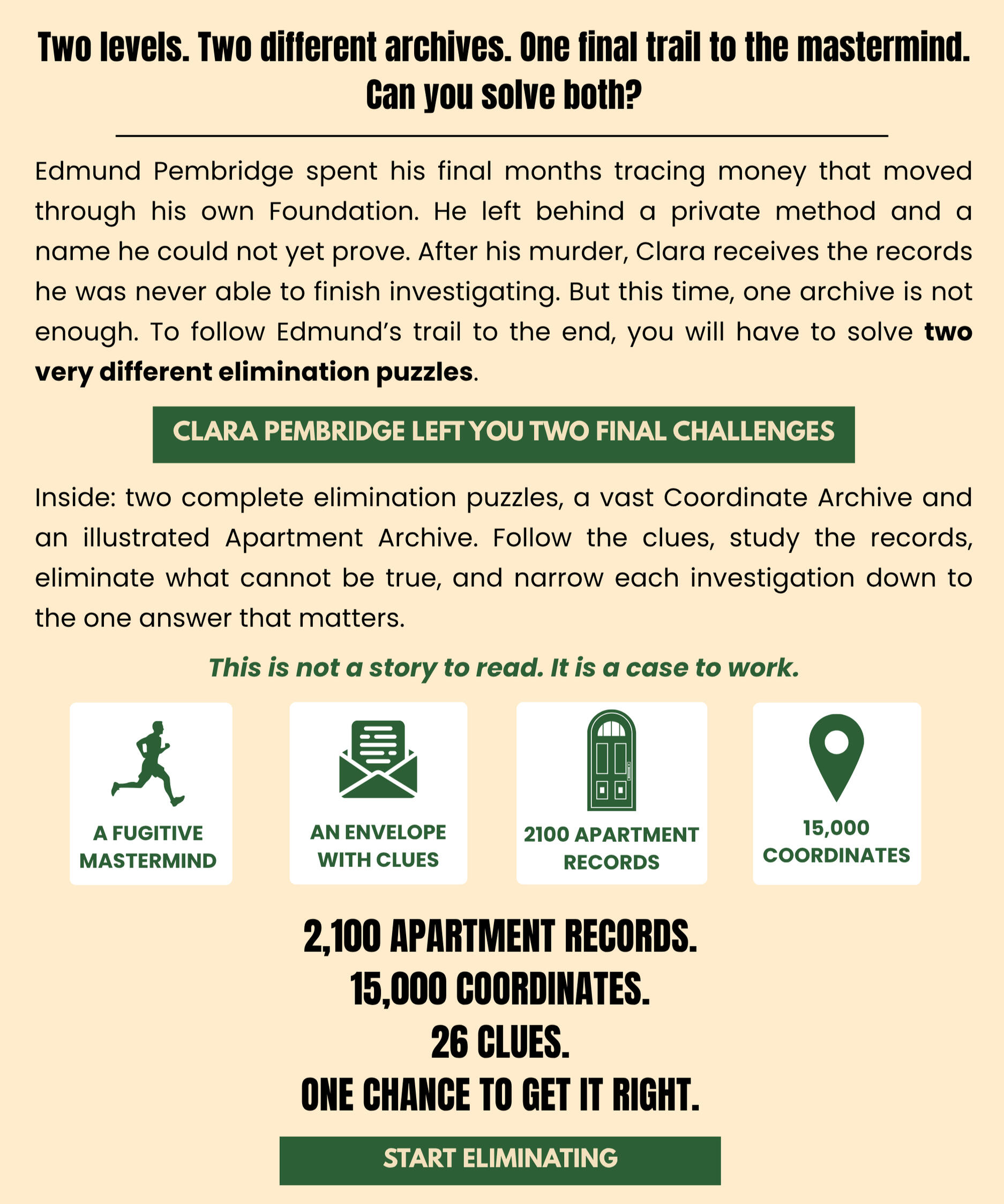
A Second Edition of The Lottery Killer: Volume 3 is now available, redesigned as a two-level investigation.Level One challenges you to eliminate your way through a Coordinate Archive until only one location remains. Level Two continues the investigation inside that location, where a separate Apartment Archive of illustrated doors must be narrowed down to the exact apartment connected to the case.If the opening pages of your copy do not state “Second Edition,” you have the original edition. Your book remains fully solvable using the archive and clues included in your copy. The Second Edition is a substantially updated version with its own archives, clues, and two-level puzzle structure, so its clues are intended to be used with the Second Edition only.
Contact
Questions, corrections, or feedback? If you found a printing issue, need clarification, or would like to share your thoughts about the puzzle, we would be delighted to hear from you at [email protected]
